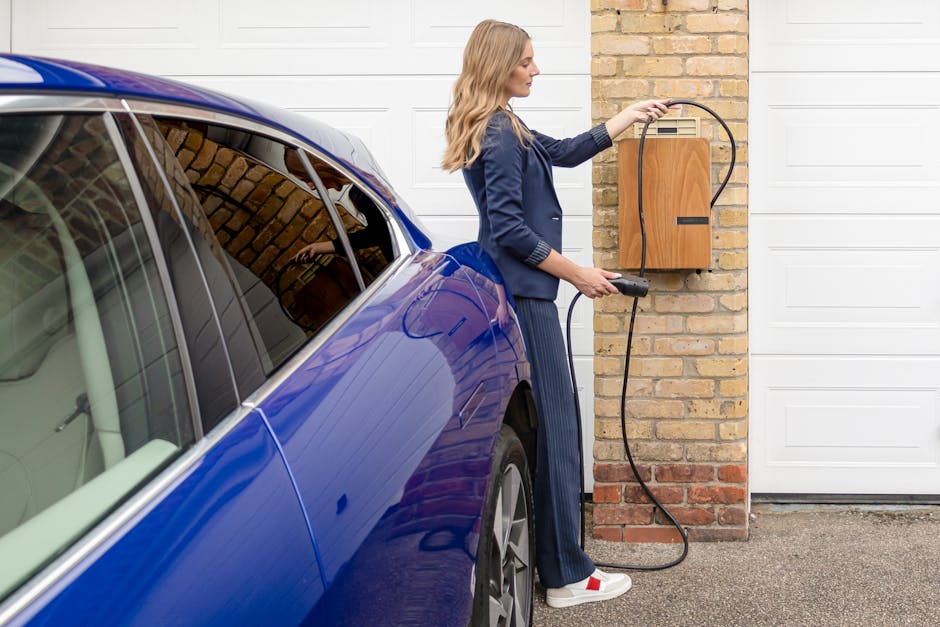
EV Chargepoint Grant 2026: £500 Explained
OZEV raised the EV Chargepoint Grant from £350 to £500 per socket on 1 April 2026. Who qualifies, and how the installer-claimed flow actually works.
EV Chargepoint Grant 2026: £500 Explained
OZEV raised the per-socket grant from £350 to £500 on 1 April 2026. Here's who qualifies, what each scheme covers, and how the claim actually works.
On 1 April 2026 the Office for Zero Emission Vehicles (OZEV) increased the maximum value of the EV Chargepoint Grant from £350 to £500 per socket across all three live residential schemes. Funding is confirmed until 31 March 2027.
If you live in a flat, rent your home, or only have on-street parking outside your house, the grant is now worth £500 towards the cost of a home chargepoint and its installation. Homeowners with off-street parking (a driveway or garage) are not eligible — the grant has not covered that group since the original Electric Vehicle Homecharge Scheme closed in 2022.
Because many published guides and supplier pages still quote the old £350 figure weeks after the change, this page focuses on what is actually true under the post-April-2026 rules — every figure is dated, and every claim is linked to its primary GOV.UK source.
What changed on 1 April 2026
Two things changed at the same time:
- The grant rate went up from £350 to £500 per socket across all three eligible groups (flats and renters, residential landlords, and households with on-street parking using a cross-pavement solution). The increase applies to applications submitted on or after 1 April 2026.
- The application platform moved to find-government-grants.service.gov.uk. The OZEV-managed portal that previously handled flats and renters applications was retired in step with the rate change.
What did not change: the grant is still claimed by an OZEV-authorised installer rather than by the customer, the eligibility framework (designated parking, OZEV-approved vehicle, third-party permissions where relevant) is unchanged, and the maximum is still one socket per household under the flats and renters scheme.
The three EV Chargepoint Grants explained
OZEV operates three parallel EV Chargepoint Grant schemes. They share the £500 rate and the same installer-claimed mechanism, but the eligibility and paperwork differ. Most households will qualify under exactly one of them — pick the one that matches your situation.
1. Flats and Renters
Who it's for. Anyone living in a flat (whether owner-occupier or leaseholder) and anyone renting their home, where the property has private off-street parking attached to the household.
What you get. £500 per socket, one socket per applicant.
Key conditions.
- The parking space must be designated, private, off-street, and you must have a legal entitlement to use it at all times.
- If you rent, you need written permission from the landlord, freeholder, or managing agent — naming you, naming them, and referencing the specific property — before applying.
- A utility bill less than three months old in your name at the address is required.
- The vehicle being charged must be on the list of OZEV-approved electric vehicles.
2. Residential Landlords
Who it's for. Landlords (private or social) installing chargepoints at residential properties they own or manage.
What you get. £500 per socket, capped at 200 sockets across all sites per landlord.
Key conditions.
- Funding is split between residential and commercial-class properties; the published guidance details the split for each financial year.
- The chargepoint must be installed by an OZEV-authorised installer.
- Landlords cannot recover the grant value from tenants beyond standard chargepoint use fees.
3. Households with On-Street Parking (Cross-Pavement)
Who it's for. Owner-occupiers and renters whose only parking is on a public street outside their home, who are pairing the chargepoint with a cross-pavement charging solution — a channel installed under the footway that lets a charging cable run from the house to the kerbside without trailing across the pavement.
What you get. £500 per socket.
Key conditions.
- The on-street parking must be lawful, generally available outside or near the home, and must not prejudice the safety or free flow of traffic or pedestrians.
- Permission from the local highways authority is required for the cross-pavement installation.
- Any planning permissions required by the local planning authority must be obtained.
- Households with private and exclusive access to off-street parking (driveway, garage, residential car park) are explicitly not eligible.
- The chargepoint must not be installed before OZEV confirms eligibility — backdated grants are not permitted under this scheme.
Who does not qualify
The biggest source of confusion is that owner-occupiers with off-street parking are not eligible for any of the three schemes. The original Electric Vehicle Homecharge Scheme (EVHS) that covered this group closed to new applications in March 2022, and the post-2022 grants were deliberately scoped to renters, flat-dwellers, landlords, and on-street parkers — the groups previously underserved by EVHS.
If you own your house and have a driveway, you can still install a home chargepoint, but you'll pay the full price (typically £900–£1,400 fitted in 2026 for a tethered 7 kW unit, more for an untethered or 22 kW unit). The EV tariff savings — Intelligent Octopus Go is currently around 7p/kWh off-peak versus a 24-hour cap of roughly 27p/kWh — are usually the larger long-run number, even without the grant.
You are also not eligible if your vehicle is not on the OZEV-approved list, if you cannot demonstrate a legal entitlement to the parking space, or if the chargepoint is being installed at a property that is not your primary residence (the flats and renters scheme is for the dwelling you live in).
How the claim actually works
All three schemes use an installer-claimed model. You don't receive a £500 cheque, and you don't apply to GOV.UK on your own behalf. The flow is:
- You apply for an eligibility voucher at find-government-grants.service.gov.uk, uploading the supporting evidence (utility bill, written landlord permission if renting, vehicle details, parking proof).
- OZEV confirms eligibility and issues a voucher reference, valid for a defined window (typically 6 months from issue, extendable on request).
- You choose an OZEV-authorised installer — most major UK installers (Pod Point, Octopus Energy, Ohme via partner installers, BOXT, Smart Home Charge) participate. The installer should ask for your voucher reference up-front.
- The installer fits the chargepoint at the post-grant price. They invoice you for the full installation, then claim the £500 directly from OZEV.
- You pay the installer the post-grant amount. If a quoted installation is £1,200 fitted, the post-grant invoice is £700; the installer recovers the £500 from OZEV separately.
Key practical points: confirm the installer is OZEV-authorised before signing a contract; check the post-grant price is itemised on the quote; and make sure the voucher reference is on the invoice. A small minority of installers quote the pre-grant price and let the customer think they will receive £500 back later — that is not how the scheme works under the current rules.
Re-applying if you applied before 1 April 2026
If you applied for a grant before 1 April 2026 at the £350 rate but your chargepoint has not yet been installed, you can reapply at the higher £500 rate. The mechanism is to register a fresh account on the new portal and submit a new application — the old voucher is then cancelled in favour of the new one.
If the chargepoint has already been installed under a £350 voucher, you cannot retrospectively claim the difference. The £150 per-socket uplift is only available on installations completed under a post-April voucher.
For renters and flat owners, the supporting evidence (landlord permission, utility bill) needs to be re-uploaded on the new platform — the old portal does not migrate documentation across automatically.
What about the Workplace Charging Scheme?
The Workplace Charging Scheme (WCS) is a separate OZEV grant for businesses, charities and public-sector bodies that want to install chargepoints for staff and fleet use at workplace sites. The 1 April 2026 changes did not affect WCS — it continues to operate at its long-standing rate of £350 per socket up to 40 sockets per applicant, claimed via OZEV-authorised commercial installers.
If you run a small business and are considering claiming WCS for an installation at your home (because you also work from home), the answer is no — WCS is for genuinely workplace sites, not residential addresses. The right route for a sole-trader homeworker is the flats-and-renters or on-street parking grant if eligible, or a personal-purchase install at full price if not.
Where the grant fits in the wider EV economics
The £500 grant is real money but it's a one-off — the recurring savings come from pairing the install with a smart EV tariff. To put it in context:
- Hardware + install for a tethered 7 kW unit in 2026 typically lands at £900–£1,400 fitted before the grant, £400–£900 net of grant.
- Smart EV tariff savings are normally £300–£700 a year for an average 7,500-mile/year driver (rough working: 7,500 miles ÷ 4 miles per kWh ≈ 1,875 kWh; the gap between a smart off-peak rate of ~7p/kWh and a default cap rate of ~27p/kWh is ~20p × 1,875 = £375).
In other words, the recurring tariff saving repays the post-grant install in about 12–24 months for a typical UK driver — and the grant brings the payback window forward by about 6 months. The decision worth getting right is the tariff, not whether to chase the grant.
For more on this, see the pillar guides linked at the foot of the article.
Is the EV Chargepoint Grant £500 or £350?
Do homeowners with a driveway qualify?
How do I actually claim the £500?
What if my application went in before 1 April 2026?
How long does the grant last?
Does the grant cover the cross-pavement channel itself?
Sources and changelog
Primary sources used in this guide. All link to GOV.UK and were checked on the date of publication.
- Changes to electric vehicle chargepoint grant schemes from 1 April 2026 — GOV.UK
- Electric vehicle chargepoint grant for renters or flat owners: What you can get — GOV.UK
- Electric vehicle chargepoint grant for renters or flat owners: Eligibility — GOV.UK
- Electric vehicle chargepoint grant for residential landlords — GOV.UK
- Electric vehicle chargepoint grants — GOV.UK
- Electric vehicle chargepoint and infrastructure grant guidance for installers — GOV.UK
- GOV-UK Find a grant: EV Chargepoint Grant for Renters and Flat Owners
- GOV-UK Find a grant: EV Chargepoint Grant for Households with On-Street Parking
- GOV-UK Find a grant: Workplace Charging Scheme
Changelog.
- 2026-05-08 — first publication. Confirmed £500 rate live across all three residential schemes, application portal moved to find-government-grants.service.gov.uk, funding confirmed to 31 March 2027.
This page is on our quarterly Ofgem-cap refresh cycle and will be reviewed at the next OZEV announcement or rate change.
Related reading
- The grant is one number; the recurring savings come from a smart tariff. See Best EV Tariffs UK 2026 for the comparison.
- Picking the right hardware matters more than chasing the grant. See Best Home EV Chargers UK 2026.
Compare every UK EV tariff
Once you've sorted the grant, the bigger lever is your tariff — postcode-aware comparison across every active UK EV tariff.